
Hello friends! Happy New Year!
I’m starting the new year with a bang by reviewing the new 2026 Dietary Guidelines for Americans (DGAs), released last week by the USDA and DHHS. The guidelines are updated every 5 years and are meant to give Americans guidance on how to eat. These new guidelines are a radical change from any previous ones, and literally turn the food pyramid on its head. Let’s take a look:
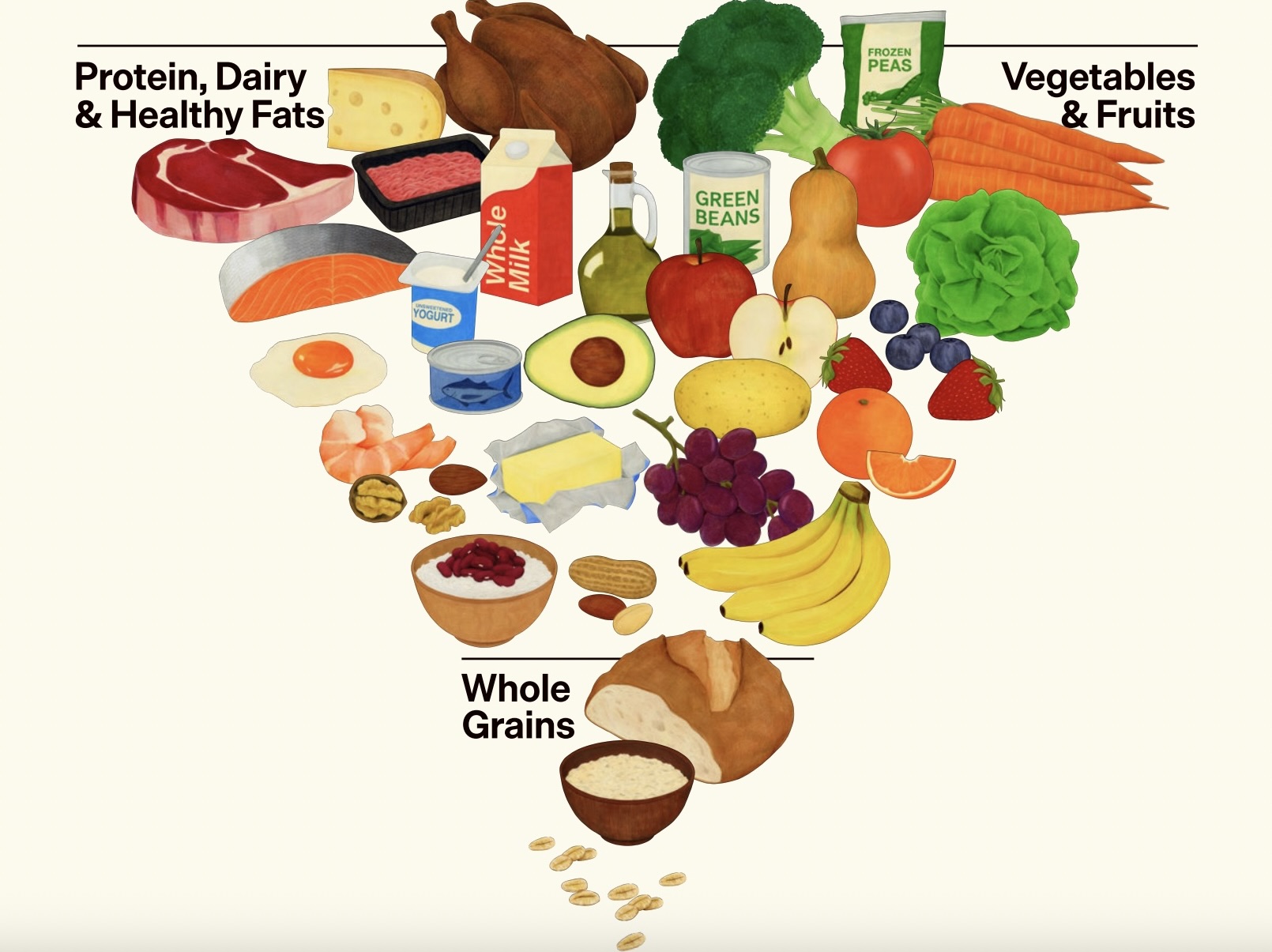
The top of the pyramid represents the foods we are supposed to eat the most of… meats and cheese, full fat dairy, and vegetables. In the middle we see fruits, seafood, nuts, and other fats including butter. Down at the bottom are whole grains, which are meant to be limited.
The 2025-2030 DGAs recommend prioritizing high-quality protein, healthy fats, fruits, vegetables, and whole grains, while avoiding highly processed foods and refined carbohydrates. Their specific key recommendations are as follows:
- Prioritize protein foods at every meal. (Protein recommendations have been increased from 0.8g/kg to 1.2-1.6g/kg.)
- Consume 3 servings of full-fat dairy products per day.
- Eat 3 servings of vegetables and 2 servings of fruit per day.
- Include healthy fats with essential fatty acids found in whole foods. Butter and beef tallow can also be included.
- Continue to limit saturated fat intake to 10% or less of total daily calories.
- Consume 2-4 servings of whole grains per day.
- Limit highly processed foods, added sugars, and refined carbohydrates.
- Consume less alcohol (no specific guidance on number of drinks per day.)
So there they are. What do we make of all this? How are we supposed to interpret these new guidelines, so very different from any others? Well, I’m hoping to simplify things by breaking it down into The Good, The Bad, and The Ugly. Let’s start with:
The Good
The new DGAs are putting emphasis on eating real food, while limiting or avoiding highly processed food. Yes! This is definitely a worthy goal! Americans are consuming, on average, 70% of their daily calories from highly processed foods. Think of things like frozen ready-to-eat meals, chips, packaged cookies and crackers, snack foods, etc. These foods are quick, easy to prepare, tasty, and relatively inexpensive compared to fresh foods. The convenience and long shelf life of highly processed foods fits right into the busy American lifestyle. But they are not so good for our health, as most of them are calorically dense and contain excess sodium, unhealthy fats, and lots of preservatives.
There is a focus on limiting added sugars and avoiding sugar-sweetened beverages. While previous guidelines recommended no more than 10% of daily calories to come from added sugars, the new guidelines take that down to 6%. This is a tiny amount, friends! In a 2000-calorie diet, this equals 24 grams of added sugar. Just for reference, one tablespoon of jam has 12 grams, a Starbucks tall caramel macchiato contains 21 grams, and one Dr. Pepper has 39 grams! It adds up fast. We could all benefit from reducing added sugars- sugar doesn’t have any nutrients besides calories from simple carbohydrate. (Great for athletes while training… but for the average American, not necessary or beneficial for overall health.)
The protein recommendations were finally updated, woohoo! This has been a long time in coming, despite decades of research indicating better health outcomes at higher protein intakes than the previously-recommended 0.8g/kg. This is especially true for older people who are susceptible to loss of muscle tissue.
The above parts of the new guidelines are commendable, based on a massive body of research, and worth pursuing. Unfortunately, several aspects of these new guidelines raise some concern:
The Bad
Americans don’t need to be told to eat more meat, especially red meat. The emphasis in the new DGAs is clearly on animal proteins, and red meat especially. Plant proteins are included, but just with a couple of nuts the middle near the butter and two little beans near the bottom, at the line just above the bread. The fact that one of the first things that pops out to you on the pyramid is a big marbled steak, is indicative of the prioritization of red meat. However, the overwhelming body of research shows that a diet high in plant proteins and lower in red meat is most protective against heart disease and certain cancers.
Fiber is waaay too low on the priority list. Whole grains are at the very bottom of the pyramid, with recommendations for only 2-4 servings per day. (So if I eat a bowl of oatmeal for breakfast, that’s it for my carbs for the day.) Legumes, one of the highest-fiber (and inexpensive… and high-protein) foods in our food supply, are barely represented, as I mentioned above. Recommendations for veggies and fruits has also decreased, from a total of 5-9 servings per day to only 5. All these things combined reduce our overall fiber intake by a large margin. This is a huge mistake, as fiber is essential to gut health, immunity, weight control, and risk reduction for heart disease, cancer, and diabetes. I think that encouraging Americans to eat more fiber will go much farther towards “Making America Healthy Again” than “ending the war on saturated fat.”
Butter and beef tallow are included as options in the list of “healthy fats.” This is just wrong. Period. No need to go on about it. Which brings me to:
The Ugly
RFK Jr promised that this edition of the DGAs would be “free of bias and politicized science.” Nothing could be further from the truth. Of the nine members of RFK’s advisory panel, 5 of them have direct ties to the beef, pork, and dairy industries in the form of funding, grants, and employment. To me, this casts the entire food pyramid in a shady light. Clearly, the “Council for Promotion of Legumes” hasn’t thrown much money towards Trump’s interests, or we would see a big fat bowl of beans at the top of the pyramid instead of a big fat steak.
I crunched some numbers using the new guidelines, at a range of different calorie levels, just to see what I would come up with. At every calorie level from 1600 to 3200, following the guidelines produced a diet that hugely exceeded the recommended limits for saturated fat (16-22% of total calories from saturated fat- recommendations are <10%.) Fiber also came nowhere near the recommended guidelines of 25-45 grams per day, falling 7-16 grams short at every calorie level. This self-contradiction is confusing for the American public, and will make an overall healthy diet difficult to achieve.
Alcohol guidelines are ambiguous and no longer include specific recommendations on how many drinks per day are acceptable. These new guidelines ignore recent research that indicate that there is no safe level of alcohol consumption. Worse yet, Mehmet Oz (head of Medicare and Medicaid) stated: “Alcohol is a social lubricant that brings people together… just don’t have it for breakfast.” This just hits me wrong… to me, his statement was irresponsible and implies that alcohol is somehow necessary for social enjoyment with our friends, and that Americans are drinking so much alcohol that “drinking less” means not having it for breakfast. Maybe he said this tongue in cheek, but it’s sending the wrong message, especially from a high-profile doctor.
The Bottom Line
I don’t deny that developing diet recommendations for an entire nation is very difficult and challenging. But overall, I’m disappointed by the new Dietary Guidelines for Americans. I believe they are heavily politically influenced, confusing, self-contradicting, and difficult to implement. The good points are that they encourage us to eat more “real food,” less sugar, and less highly processed food. But the emphasis on red meat and saturated fats, along with the de-prioritization of high-fiber foods and plant sources of protein, will not “make America healthy again.”
I realize that this post lacks my usual lighthearted style, so thanks for staying with me. But I feel a heavy concern about the direction that these new food guidelines are leading my country. So it’s my commitment to you, friends, to make the most of my little corner of the Internet to provide accurate health information, really healthful and yummy recipes, and nutrition guidance that you can actually follow. Cheers to a healthy 2026!
The Good: I can go back to Wolfgang’s this weekend
The Bad: I shouldn’t get the marbled steak when I go, just a potato or legumes
The Ugly: Can’t go for breakfast and have a large pour at the bar
Thanks for setting the record straight, Bec. My humor aside, I can only imagine how most people will interpret the new guidelines and only hear what they want to hear… Good for Wolfgangs and Texas Roadhouse!
Hahaha… exactly! Yes great for steakhouses and cardiologists!
I was looking forward to hearing your take on this, Rebecca! So nice to be immediately gratified!
Haha, thanks, Christa! I couldn’t get it off my mind since it came out!
Way to go Rebecca!! I still will always value your advice over a self serving government recommendation. 100% agree with you on all of it!
Thank you Sarah! It makes me sad that we can’t trust our government agencies to give us accurate and non-biased information.
Really interesting read Rebecca- food advice is overwhelming these days – I always hope I’m doing ok feeding my family but so much contradictory advice- I read about nutrition A LOT but even with this knowledge it can be hard ! x
It is really difficult to wade through, Louise… so much info out there and not all of it is accurate. From what I know of your nutrition habits, you are doing a great job feeding your family! 🙂 xx
I appreciate this post! Thanks for posting it! I shall look forward to the healthy recipes I have come to know and use from this blog!
Thank you, my sweet aunt… I appreciate your support so much! xoxo
This is a great take and I love hearing your thoughts! Thank you so much for sharing!! These new guidelines are so crazy and I loved your comment about “Americans don’t need to be told to eat more meat” hahaha!